Author: Ranadeep Tujala

  • Mama, How Would You Design PUBG and Call of Duty?

    Mama, How Would You Design PUBG and Call of Duty?

    One day my nephew asked me:

    Mama, you work on games, right? How would you design Call of Duty and PUBG–kind of games?”

    (In our family I am Mama— uncle.)

    He expected a short answer — maps, guns, graphics, maybe a cool explosion.

    I almost said “it’s complicated.” Then I realized he had asked the right question for an architect not how the game looks, but how the system is arranged so players can find a match, stay in sync, and not melt the servers when a whole country logs in after school.

    So I answered him the way I wish more design conversations started — with a map.

    Not Erangel. Not Verdansk.

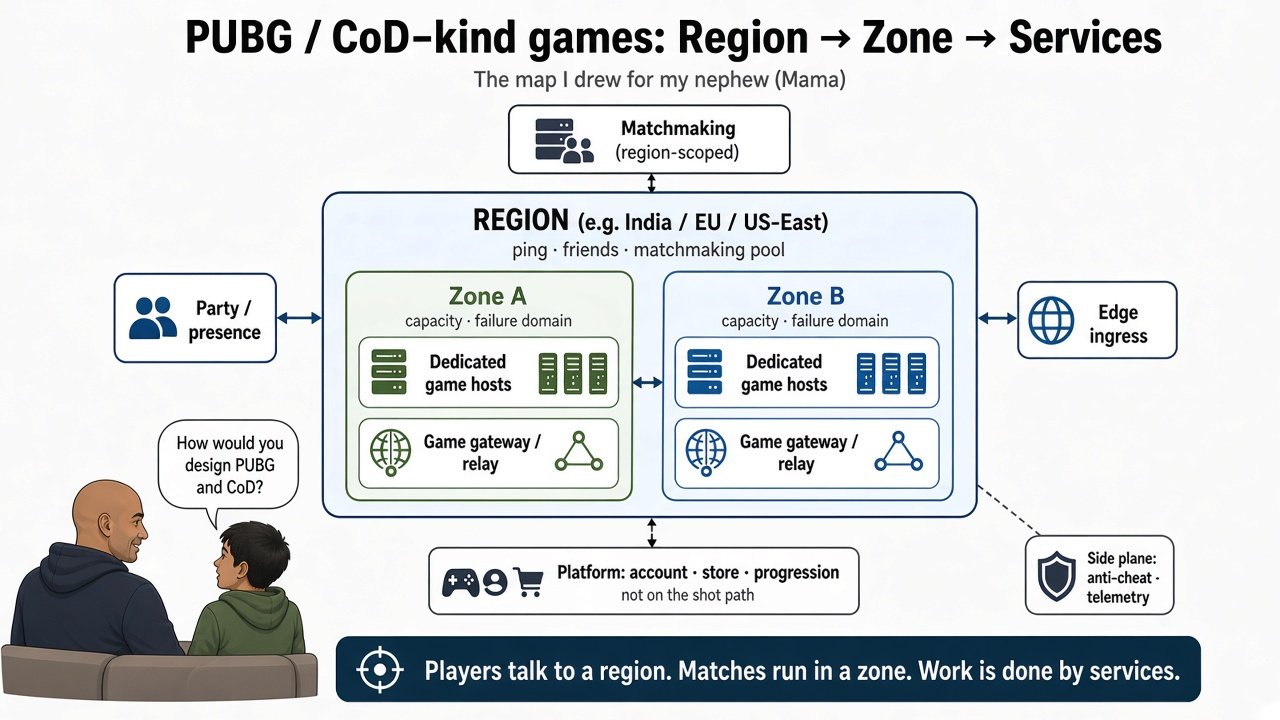
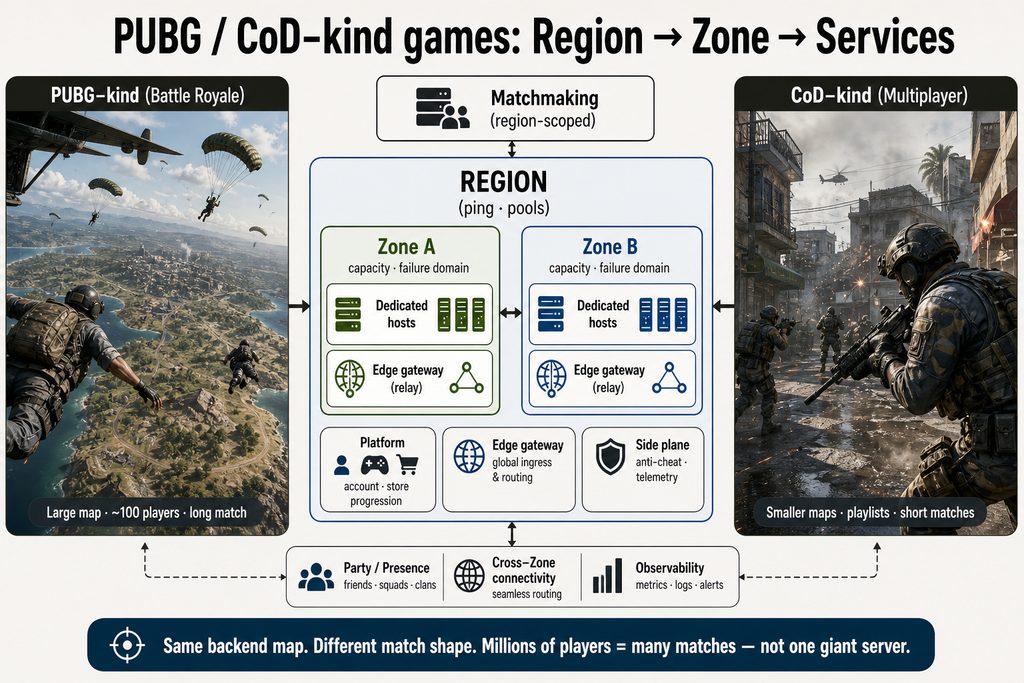
    A map of regions, zones, and services.

    This article is that answer. It is not a leak of PUBG’s or Activision’s private blueprints. Those backends are not fully public. It is how PUBG-like battle royale and Call of Duty–like multiplayer systems are typically shaped — the same vocabulary we use when we design high-scale live games: where the player lands, where the match runs, and which services do the work.


    Draw the map before you name a tool.

    LayerPlain meaningDesign rule
    RegionGeography for ping, friends, and often data rules (India, EU, US-East…)Matchmaking pools and “who can play with whom” are usually region-scoped
    ZoneCapacity and failure slice inside a region (AZ / cluster / pod group)A zone can die without killing the whole region; matches drain carefully
    ServiceA job the software must do (matchmaking, dedicated game host, store, anti-cheat)Put each job where latency and ownership demand — not where the slide looks busy

    Mama’s rule: Players don’t talk to “PUBG” or “CoD.” They talk to a region. Matches run in a zone. Work is done by services.

    If you cannot place a component on that map, you are not designing yet. You are collecting logos.

    Naming trap — three different “zones”

    Kids (and engineers) mix these up:

    1. Cloud / infra zone — failure domain and capacity (this article’s “Zone”)

    2. Map / safe zone — the shrinking circle in a battle royale

    3. Interest / AOI zone — which other players and objects your client needs to know about right now

    Same English word. Three layers. Keep them separate or the design review becomes comedy.

    Walk one player from the sofa to the victory screen.

    Here is the journey I walked with him — overlaid on the map.

    1. Launch / login → hits platform services (identity, entitlement). Often multi-region capable, with a home region.

    2. Lobby / party → region-aware presence: you queue with friends who share a sensible ping story.

    3. Matchmaking → region-scoped queues (skill, playlist, fill rules). Output: “here is your match” + where to connect.

    4. Connect to the match → client is steered to a dedicated game host (or relay path) sitting in a zone inside that region.

    5. In match → authoritative simulation ticks; state replication; interest management; voice often match- or region-local.

    6. Match end → results hand off to progression / inventory / battle pass (platform path — not on every bullet).

    7. Side planes (always on) → anti-cheat signals, telemetry, crash reports — async, must not block the tick.

    This is the same shape as systems I have lived with in live gaming

    matchmaking as a door (ask and get placed), then a live channel / dedicated path as the room (stay connected for the session). Different genre. Same map logic.

    What sits where — service placement.

    ServiceTypical place on the mapWhy
    Identity / accountPlatform (multi-region or hub + cache)Shared identity; not every shot
    Store / battle pass / inventoryPlatformMoney and catalog; after or beside the match
    Friends / party / presenceRegion-awareParties hate cross-ocean ping
    MatchmakingRegionPool quality + latency
    Dedicated game servers / match instancesZone inside regionBlast radius; capacity; drain on failure
    Real-time game gateway / relayEdge / regionLow latency into the match
    VoiceMatch- or region-localLatency and moderation scope
    Anti-cheat (client + server signals)Match-local collect → hub aggregateHot path light; intel can be global
    Telemetry / analyticsSide plane → lakeNever block the tick
    Content / config catalogHub + CDNVersioned rules, maps, playlists

    Hot path rule: bullets, movement, and tick authority stay near the player (region / zone). Store, heavy CRM, and batch analytics do not sit on the shot path — same lesson as handing wallet work off a live game loop.

    Same map — different match shape (PUBG-like vs CoD-like)

    I did not crown a winner. Both sit on Region → Zone → Services. The match they host looks different, so the fleet math changes.

    ConcernPUBG-like battle royaleCoD-like multiplayer modes
    Match shapeLarge map, many players, longer sessionSmaller maps, shorter matches, many playlists
    Dedicated fleetFewer, heavier matches per hostHigher match churn; faster spin-up / teardown
    In-match pressureWide map + vehicles + loot; strong AOI neededTighter spaces; higher tick / precision pressure
    Region pressureLaunch and country spikes; fill 80–100 seatsPlaylist and seasonal spikes; many small rooms
    What stays identicalRegion routing, zone isolation, platform vs game split, async side planesSame

    And, not vs: PUBG-kind and CoD-kind games are not rival architectures. They are two workloads on one map.

    Region design — what my nephew already understood as “ping”

    Ping budget decides who can share a match comfortably.

    Party constraints beat “perfect MMR” if the squad cannot hear each other in time.

    Empty lobby risk — a region that is too fine-grained never fills; too coarse and someone plays on 180 ms.

    Data and policy — some player data and commerce prefer staying in-region.

    Spill / overflow— when a region is on fire, you need a written rule (queue, wait, or rare cross-region with honesty about ping).

    Region is a product decision as much as a cloud dropdown.

    Zone design — why we don’t put every match in one basket

    Inside a region, zones exist so that:

    Hardware or AZ failure takes some capacity, not all evening matches

    You can drain live matches (finish or migrate carefully) instead of hard-killing everyone

    You scale dedicated fleets in slices — warm pools, playlist packs, BR vs small-modes packing

    If matchmaking returns a host, that host’s zone is part of the placement decision — not an afterthought for Ops.
    In-match: who owns the truth

    For both genres, the dedicated (or authoritative) simulation owns match truth: positions, damage, win conditions. Clients predict for feel; server corrects for fairness.

    That is the same ownership lesson as a live game table :many concerns in flight (inputs, timers, broadcasts), but one clear writer of shared state beats “a thread per player mutating the pot.” Concurrency is required. Chaos is optional.

    Interest management (AOI) decides what to send whom — critical on a big BR map, still important in tight CoD lanes. That is game zoning, not your cloud zone.

    One contest, a million players” — how scale actually works

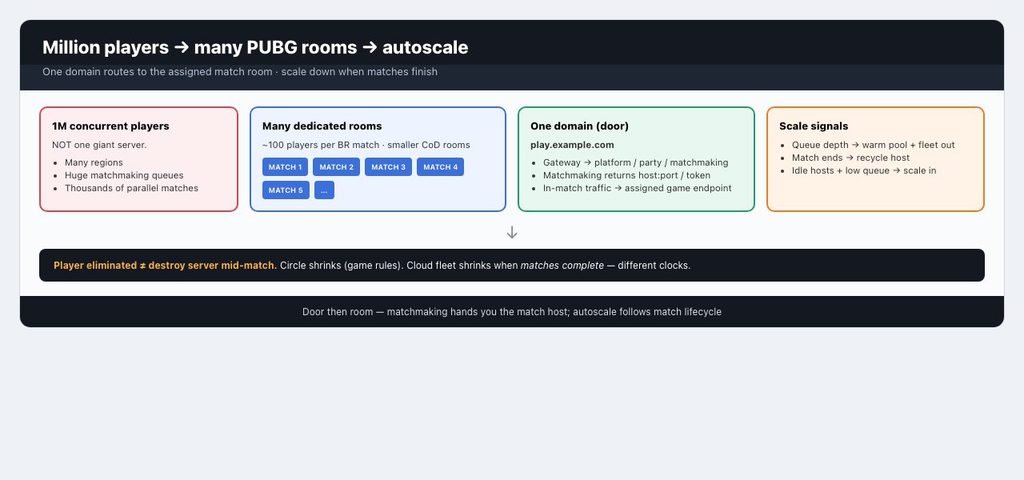
    This is the question my nephew asked next: if a big contest has millions of players, do you build one giant server? When people die, do servers shrink? How does one website send everyone to the right place?
    First correction — millions are not one match

    A PUBG-like battle royale match is on the order of 100 players (squads fill seats). A CoD-like mode is often fewer per room.

    A million concurrent players means roughly:

    many regions taking traffic

    huge matchmaking queues

    thousands / tens of thousands of matches in parallel

    each match on a dedicated host (or a packed host running N matches) inside a zone

    So the platform scales by creating many small rooms, not by stuffing a million people into one simulation. One match still has one authoritative world. Parallelism across the system is many matches at once the same idea as many live tables running together.

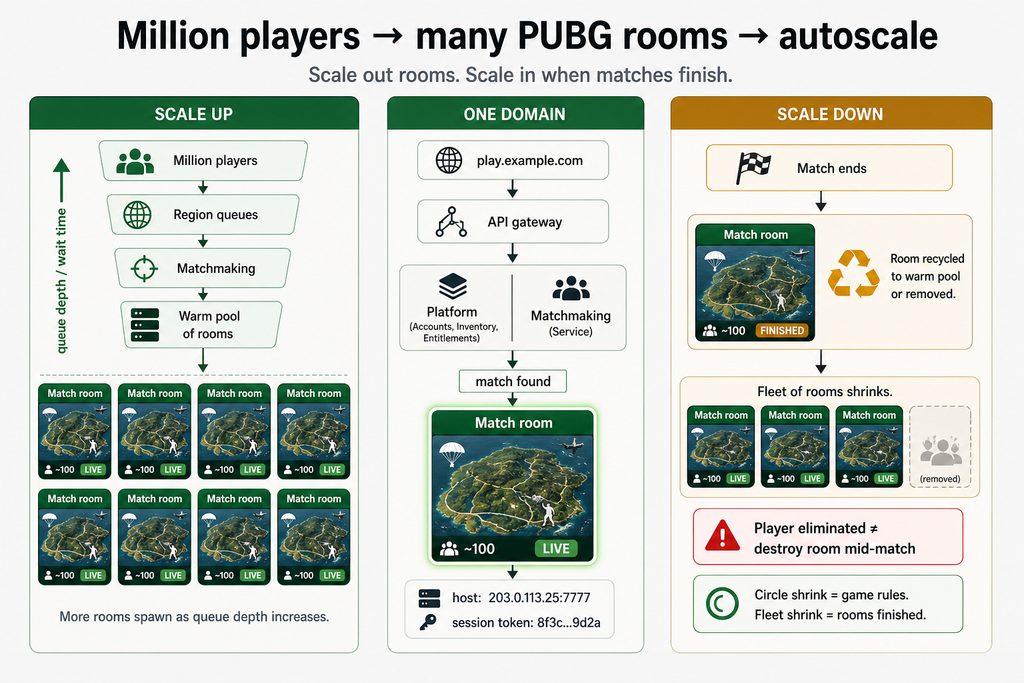
    Scale up — when the lobby catches fire

    Autoscaling is driven by signals, not vibes:

    SignalWhat scales up
    Login / store spikePlatform pods / gateway capacity
    Queue depth / wait timeMatchmaking workers + dedicated game fleet
    Assigned matches with no free hostWarm pool → cold start more game servers in the zone
    Telemetry / anti-cheat volumeSide-plane consumers (async)

    Typical dedicated-fleet pattern:

    1. Keep a warm pool of ready game hosts per region/zone (already loaded build, waiting).

    2. Matchmaking fills a lobby → allocates a host (or a match slot on a packed host) → returns connection info to clients.

    3. If warm pool is empty and queue is deep → scale out more hosts (VM/container/bare metal — product choice).

    4. Cap scale with max so a bug cannot bankrupt you; spill to “queue longer” rather than infinite machines.

    Platform and matchmaking scale on HTTP/API metrics. The game fleet scales on matches needing a home.

    Scale down — when the game finishes (not when one player dies)

    When a match ends:

    1. Dedicated host writes results → hands off to progression / rewards (platform).

    2. Players disconnect from that match path.

    3. Host is recycled (back to warm pool) or terminated if pool is fat.

    4. Autoscaler watches idle hosts + queue depth → scale in slowly (hysteresis), so a two-minute lull does not thrash.

    Important: when players are eliminated mid-match (“next circle, fewer alive”), you usually do not tear down or resize away the dedicated server. The match is still live until a winner (or draw) is declared. What can drop is work inside the match:

    fewer clients to replicate to

    lighter AOI / bandwidth

    fewer voice peers

    The map safe zone shrinks (game rules). The cloud zone fleet shrinks when matches complete and demand falls — different clocks.

    Eliminated players often return to lobby / spectate / platform that traffic moves back to lobby and platform services, while the match host keeps serving survivors.
    One domain — how everyone reaches the right service

    Players remember one name: `play.example.com` or the game client’s embedded API host. Behind that single domain:

    Client
      → DNS (often geo / latency aware) → regional edge
        → API gateway / load balancer
             ├─ /auth /store /profile     → Platform services
             ├─ /party /presence          → Region-aware social
             ├─ /matchmaking              → Matchmaking
             └─ after “match found”
                  → dedicated host or game gateway
                     (host:port / token / session from matchmaking — not the store URL)

    (host:port / token / session from matchmaking — not the store URL)

    So:

    One public front door (domain + gateway) for lobby and platform.

    Matchmaking is the redirector in product terms— it tells the client which game service/host owns this match.

    In-match traffic often goes straight to the assigned game endpoint (UDP/dedicated), not through the store cluster.

    Sticky cookies / tokens / session tickets bind “this player → this match host” for the life of the session.

    That is the same door then room idea: REST (or similar) to get placed; persistent/realtime path to play.

    What “services change” as the match levels up

    MomentWhat changes
    QueuingMatchmaking + platform busy; game fleet warming
    Match startOne host owns that match; clients leave matchmaking hot path
    Players eliminated / circle shrinksGame rules + AOI load change; dedicated host stays
    Match overHost frees; progression spikes briefly; fleet can scale down
    Contest evening endsQueue collapses → scale in matchmaking and game fleet toward baseline

    Services do not randomly morph mid-bullet. Ownership moves along the journey: platform → matchmaking → dedicated match → platform again. Autoscaling follows which layer is busy, match by match, region by region.

    What not to put on the map’s hot path

    Charging a card on every elimination

    Synchronous “call the data warehouse” mid-fight

    Treating matchmaking REST polls as the game loop

    One global region “because simpler”

    One mega-zone “because Kubernetes”

    Draw the map. Then pick UDP, dedicated hosts, queues, and stores into the boxes — not instead of the boxes.

    Wrapping-Up

    My nephew wanted guns and maps. I gave him regions, zones, and services.

    Region— where the player belongs for ping and pools.

    Zone — where this match’s capacity and failure story live.

    Services— the jobs: platform, matchmaking, dedicated simulation, edge, side planes.

    PUBG-kind and Call of Duty–kind games share that map. They differ in match shape and fleet churn, not in inventing a different physics of distributed systems.

    Mama’s rule: draw the map before you name the tool.

    Mama’s second rule: a million players means many matches and an autoscaler with a warm pool — not one infinite server that shrinks every time someone is eliminated.

    When someone asks how you would “design PUBG or CoD,” start with: Which region? Which zone? Which service owns this moment in the player’s journey? Then ask: What signal scales that service up — and what event lets it scale down?

    One honest caveat: this design is my assumption — a teaching map from how large multiplayer backends are typically shaped, and from patterns I have used in live gaming. It may not be the exact architecture the owners of PUBG or Call of Duty run in production. Their real systems will differ in topology, naming, vendors, and secrets we do not see. Use the map to think; do not treat it as a reverse-engineered blueprint.
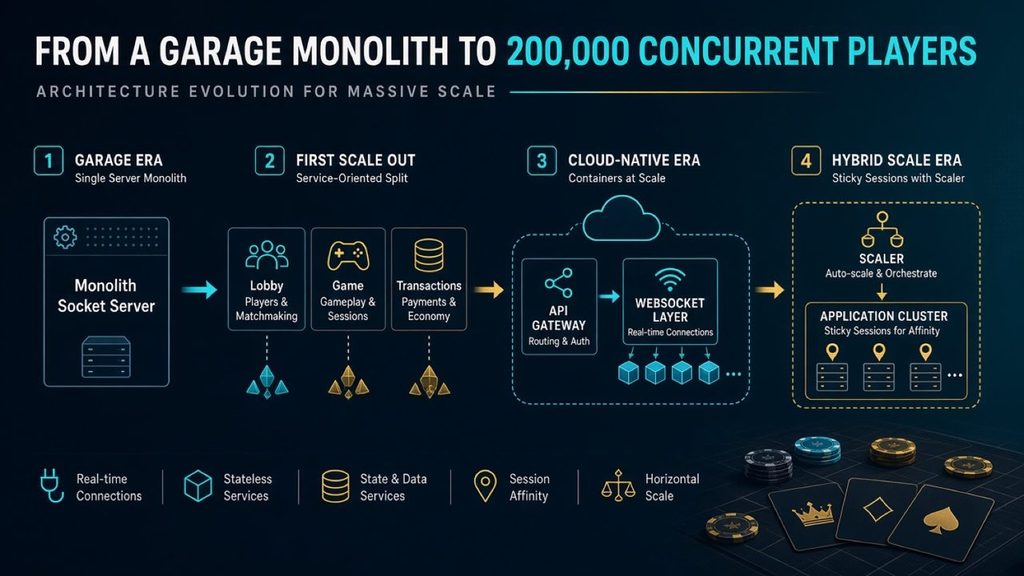
  • From a Garage Monolith to 200,000 Concurrent Players

    From a Garage Monolith to 200,000 Concurrent Players

    How our game server evolved from a monolith to micro game servers

    When I started my career at an Indian gaming startup called a23.com, I had no idea I was about to get a front-row seat to one of the hardest problems in online gaming: scale.

    I joined a small team – just me, my CEO, and a mentor who doubled as my manager – and I was handed the backend. My job was to build the game server – the piece that keeps everyone in a match synchronized, fair, and connected. In the early days, “scale” meant something modest. We were happy to serve 20 to 100 concurrent players without things falling over.

    In the beginning: one socket server to do everything

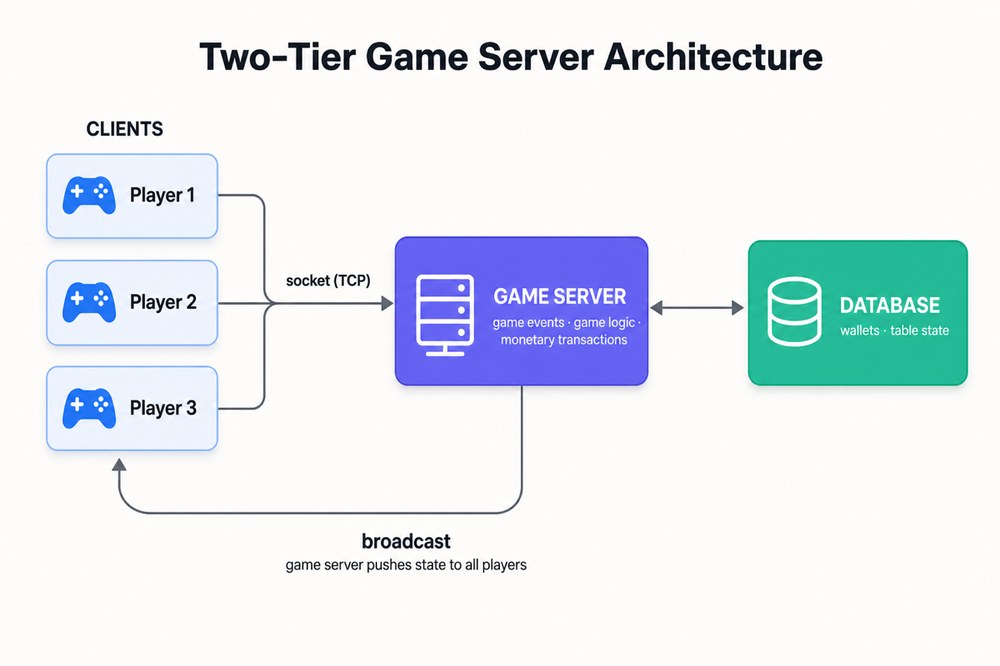
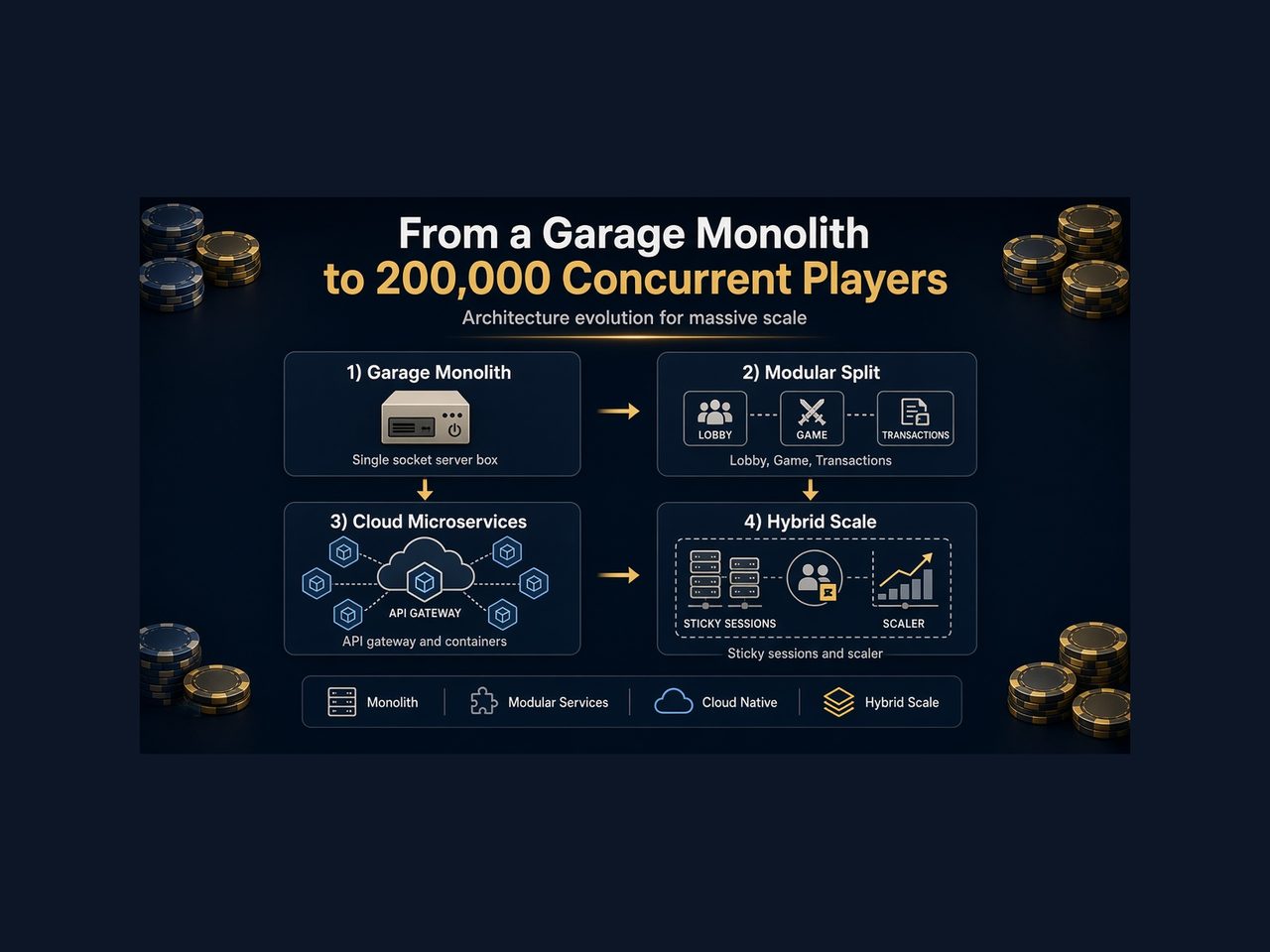
    We started simple. The whole backend was a single socket server, and it did almost everything.

    Clients didn’t talk to a web API or a queue — they opened a persistent socket connection straight to the game server and stayed connected for the life of the session. That one server carried the entire weight of the game:

    Game events — every move, deal, and turn at the table.

    Monetary transactions — wallets, buy-ins, and payouts, all real money.

    State and broadcasting— keeping every player at a table in sync.

    The loop was beautifully straightforward. A client would send an input over its socket. The server would receive it, process the game logic, update the table state, and broadcast the result to every player seated at that table. Take input, compute, fan out — that was the heartbeat of the whole game.

    It was a classic two-tier architecture — clients on one side, a single game server (with its database) on the other

    For 20 to 100 players, this was perfect. One process, one connection per player, one place to reason about everything. We could hold the entire system in our heads.

    That simplicity was exactly what would later break.

    The smartphone wave: when traffic stopped being polite

    Around 2010, the ground shifted under us.

    Smartphones were suddenly everywhere, and cheap, fast mobile internet — 3G, then 4G — put a gaming client in everyone’s pocket. People who’d never owned a PC were now playing on the bus, in queues, on their lunch break. For the business, this was a dream. For our backend, it was a flood.

    Traffic didn’t grow politely. It surged. And our single monolithic server, the one we used to hold entirely in our heads, started to strain. It could still work — but “perfectly” was off the table. One process trying to do game events, money, and broadcasting for an ever-growing crowd was a bottleneck waiting to happen.

    We weren’t just trying to survive today’s load. We were getting ready for 10x the traffic.

    Step 1: Split the monolith by responsibility

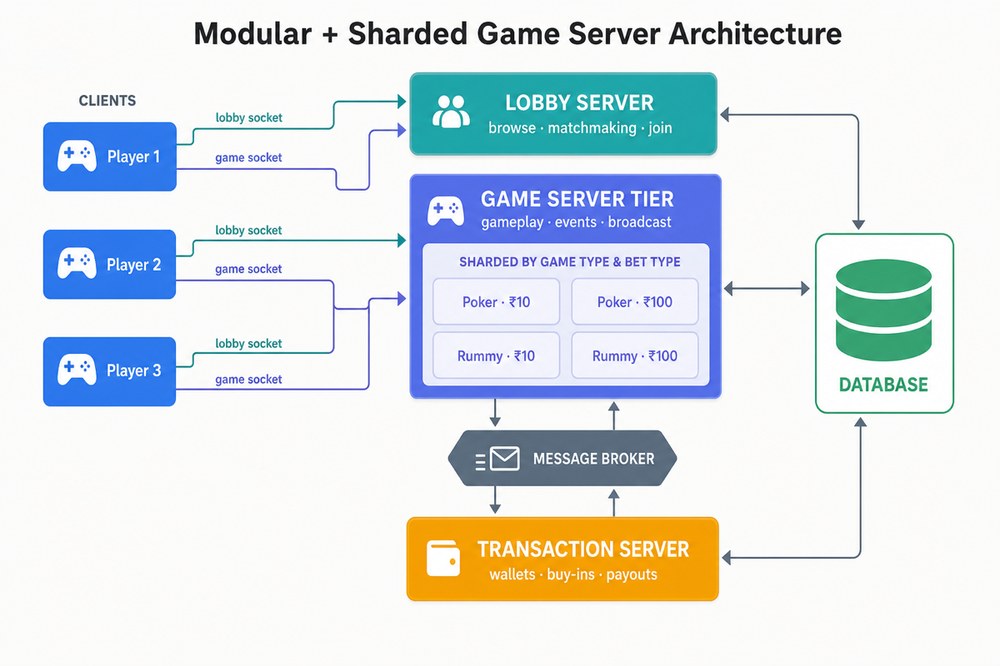
    The first move was to stop making one server do everything. We broke the monolith into modular servers, separated by domain— each one owning a clear slice of the system:

    Lobby server — players browsing, joining, and matchmaking into tables.

    Game server — the actual gameplay: events, table state, broadcasting.

    Transaction server— wallets, buy-ins, payouts, and everything money.

    Crucially, there was no single gateway in front of these. The client connected to each service directly: one socket to the lobby server for browsing and matchmaking, and a separate socket to the game server once it sat down at a table. Two independent connections, each to the service that owned that part of the experience.

    The transaction server sat slightly apart. Instead of talking to it over a direct socket, the game server and transaction server communicated through a message broker. When money needed to move — a buy-in, a payout — the game server published a message and let the broker carry it to the transaction server, rather than blocking gameplay on a synchronous call. This kept the money path decoupled and reliable even if transactions queued up under load, the game kept running.

    Now a spike in people browsing the lobby couldn’t drag down a live game, and a heavy moment in gameplay didn’t put financial transactions at risk. Each concern could scale — and fail — on its own.

    Step 2: Shard the game servers

    Splitting by responsibility bought us room, but a single game-server tier still couldn’t hold all the live tables at scale. So we sharded it.

    Instead of one game server for everything, we ran many — and assigned each shard by game type and bet type. A specific game at a specific stake had its own dedicated game servers. Players were routed to the right shard for the table they wanted to play.

    Sharding gave us two things we badly needed: horizontal scale (just add more game servers for the hottest game/bet combinations) and isolation (a problem on one shard didn’t ripple across the whole platform).

    From garage startup to enterprise: the move to microservices

    By 2020, the company I’d joined in a garage wasn’t a startup anymore. It had grown into a full enterprise gaming company. We’d added game after game, and the player base had exploded to 80 million registered players, with up to 200,000 (2 lakh) concurrent players at peak.

    Our modular, sharded setup had carried us a long way but the rules of the game had changed again, and this time the pressure came from two directions at once:

    Management wanted to optimize infrastructure cost. Running fleets of always-on servers sized for peak traffic meant paying for capacity we didn’t use most of the day.

    The business wanted on-demand scaling without manual intervention. When a tournament or a festival spike hit at midnight, no one should have to wake up and spin up servers by hand.

    Meanwhile, cloud computing had matured. What used to mean racking our own machines could now be rented, automated, and scaled by API. The timing was right to rethink the foundation.

    So we made the leap: containerization with Docker, on a major cloud provider, and a full move to microservice architecture.

    Each piece of the system lobby, game shards, transactions, and everything that had grown around them — became an independent, containerized service. That shift gave us the three properties an enterprise platform at this scale can’t live without:

    Auto-scaling — services scale up when traffic surges and scale back down when it fades, so we pay for what we actually use. We drove this with CPU-based scaling when a service’s CPU utilization crossed a threshold, the platform automatically added more containers, and removed them again once load eased.

    Fault tolerance — if one container dies, it’s automatically replaced; a single failure no longer takes down the experience.

    High availability — the platform stays up through deploys, spikes, and hardware hiccups, because no single instance is a point of failure.

    This was the moment our “game server” stopped being a server at all. It became a living fleet of micro game servers — spinning up and winding down on their own, healing themselves, and absorbing 200,000 concurrent players as a matter of routine rather than a fire drill.

    Step 1: Make the game engine stateless

    Auto-scaling sounds great until you ask the hard question: if any container can be killed and replaced at any moment, where does the game state live?

    In the old world, a game server held the table state in its own memory. That’s fine when a player is pinned to one server for the whole session — but it’s fatal for auto-scaling. If that one instance dies, the table dies with it. And you can’t freely add or remove nodes if each one is the only place its tables exist.

    So the first and most important move was to separate game state from the game engine.

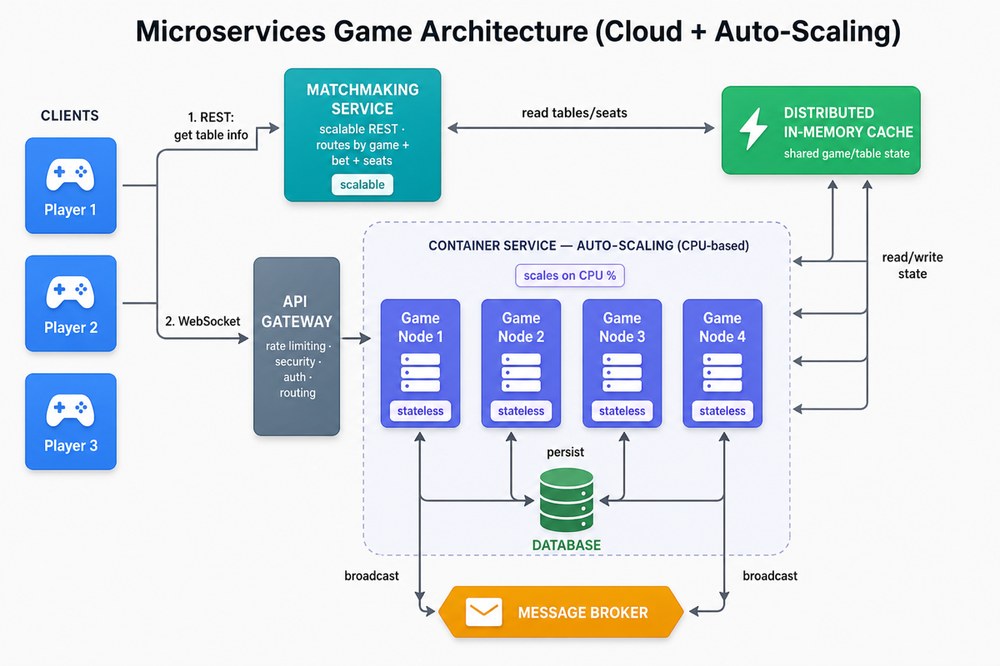
    We pulled table state out of the engine’s local memory and into a distributed in-memory cache. State now lived in a fast, shared layer that every game node could read and write — not locked inside a single process.

    With state externalized, the game engine itself became stateless.Any game node could now serve any player: it would simply pull the current table state from the cache, apply the move, write it back, and broadcast the update through the message broker to everyone at the table.

    That one change unlocked everything else. Because no node “owned” a table anymore, we could add nodes, kill nodes, and reschedule containers freely— exactly what auto-scaling and fault tolerance require.

    On top of that, we added a few more pieces to complete the picture:

    A matchmaking service — a scalable REST service that the client calls first. Based on matchmaking rules (game type, bet type, seats available, and so on), it picks the right table and returns the game table info to the client. It reads the live picture of tables and seats from the cache to make that decision. Only after this does the client know where to play.

    WebSockets for clients— we upgraded the client connections from raw sockets to WebSockets, a better fit for a modern, containerized, cloud-fronted platform.

    An API gateway in front of the WebSockets — clients now connect through an API gateway rather than straight to a node. That let us lean on gateway features we’d otherwise have to build ourselves: rate limiting, security, authentication, and routing.

    Game engines on a container service — the engine ran as containers on the cloud’s container platform, ready to be scaled and replaced on demand.

    Put together, the flow became beautifully elastic. A player first calls the matchmaking REST service, which looks at the available tables in the cache and hands back the game table info. Armed with that, the client opens a WebSocket to the game services for that table, and any available game node can serve them — reading and writing state in the cache, persisting to the database, and fanning out updates through the broker. No node is special. No node is irreplaceable.

    Step 2: The hybrid stateful redesign

    The stateless design was elegant — but at our peak, elegance got expensive.

    At full load we were processing roughly 300,000 (3 lakh) concurrent game events. Because the engine was fully stateless, every one of those events meant a round-trip to the cache and a broadcast through the message broker — and since players at the same table could land on different nodes, nodes had to chatter with each other to stay in sync. Two things started to hurt:

    The message broker was spiking, straining under the sheer volume of events flowing through it.

    The game engine burned resources on inter-node communication, coordinating state that lived everywhere and nowhere.

    Pure statelessness, it turned out, had a cost of its own. So we went looking for a middle path – a hybrid design that kept the operational benefits of microservices but stopped paying the per-event tax.

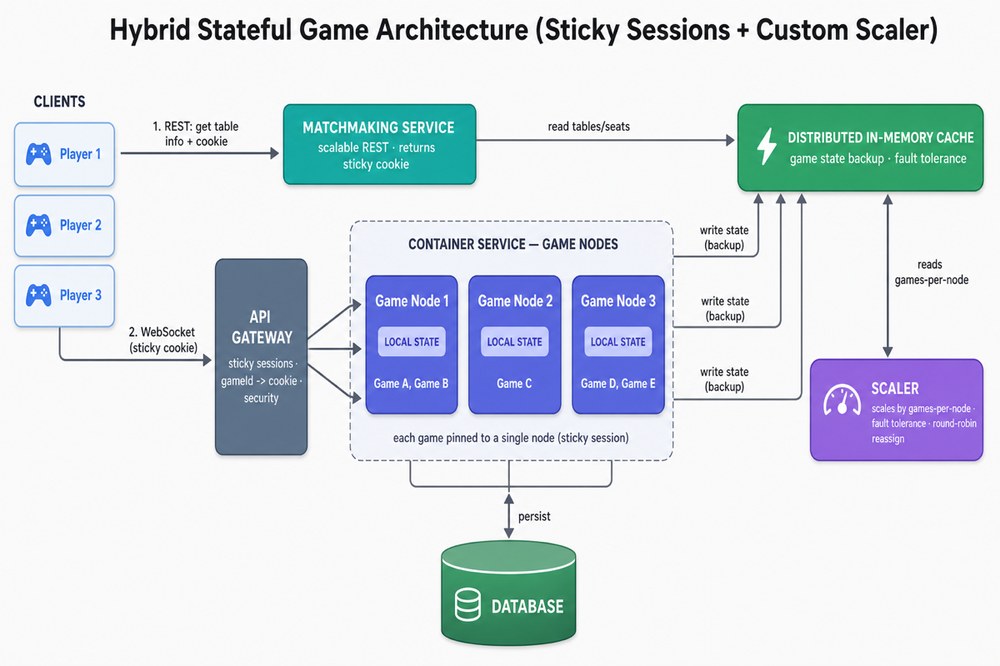
    The core idea: pin one game to one node.

    One game, one node. Each game runs entirely on a single game node, which keeps that game’s state in local memory.Gameplay reads and writes happen in-process — no cache round-trip, no cross-node coordination, per move.

    Sticky sessions via the API gateway. We map each `gameId` to a gateway cookie, creating a sticky session that always routes a given game on a given node. One sticky session = one game on one node.

    Matchmaking hands out the cookie. When the matchmaking service places a player at a table, it returns the cookie along with the table info. The client uses that cookie to connect — through the API gateway — to the same node hosting that game table, every time.

    Because all the players of a table now share one node, the engine can use local state for live gameplay. That single change let us dramatically cut message-broker traffic and game-server resource usage the inter-node chatter and constant broadcasting largely went away.

    But we didn’t abandon the cache. We still write game state to the distributed cache in the background. Local memory makes gameplay fast; the cache is our safety net – it’s what makes the system fault tolerant, because a game’s state can be recovered even if the node holding it disappears.

    A custom scaler service

    There was one more problem: CPU is the wrong signal for this workload.A node hosting many low-activity tables and a node hosting a few intense ones can show similar CPU, even though their real load — number of games — is very different. So we dropped CPU-based scaling and built our own.

    We added a dedicated Scaler service that owns both scaling and fault tolerance, driven by a metric that actually matters for us: the number of games per node.

    Scaling. Game nodes scale out and in based on how many games each node is hosting, not CPU. When games-per-node climbs past our threshold, the scaler adds nodes; when it falls, it removes them.

    Fault tolerance. When a node crashes, the scaler spins up a replacement and redistributes the failed node’s games across the remaining nodes in round-robin — rehydrating each game’s state from the cache. Players are reconnected to a healthy node, and play continues.

    This hybrid model gave us the best of both worlds: the speed of local state for 300,000 concurrent events, and the resilience and elasticity of microservices for 200,000 concurrent players —without melting the message broker in the process.

    Wrapping up: what a decade of scaling taught me

    When I look back at the journey — from a single socket server in a garage to a self-healing fleet of micro game servers serving 200,000 concurrent players — the most striking thing isn’t any one piece of technology. It’s that every stage was the right answer for its moment, and the wrong answer for the next one.

    A few lessons stuck with me:

    Start simple. Embarrassingly simple.That one monolithic socket server was the right call at 100 players. If we’d begun with microservices, sharding, and a custom scaler, we’d have drowned in complexity before we ever shipped. Architecture should match the problem you have, not the one you imagine.

    Scale arrives because of the business, not the tech. Every rewrite was triggered by something outside engineering — smartphones, cheap data, 80 million users, a finance team watching the cloud bill. The best architecture decisions came from listening to where the business was heading.

    Split by responsibility before you split by scale. Breaking the monolith into lobby, game, and transaction services bought us clarity and isolation long before sharding bought us raw throughput.

    There is no “correct” answer on state. We went stateless to unlock auto-scaling, then deliberately walked back toward local state when statelessness got too expensive. Stateless vs. stateful isn’t a religion — it’s a trade-off you re-evaluate as load changes.

    Measure what actually matters. CPU looked like a scaling signal until it lied to us. Switching to games-per-node a metric tied to real load made scaling and fault tolerance finally behave.

    Decoupling is what lets you sleep. Message brokers, caches, sticky sessions, a dedicated scaler almost every hard-won improvement was really about making one part of the system fail without taking the rest down with it.

    If you’re early in your own scaling journey, don’t try to leap straight to the final diagram. Build the thing that works today, watch where it hurts, and let the pain point you to the next architecture.That’s not a failure of planning — that’s how systems that handle hundreds of thousands of players actually get built.

    We didn’t design our way to 200,000 concurrent players in one shot. We evolved there, one bottleneck at a time.

  • Predictions at High Scale

    Predictions at High Scale

    As an Enterprise Architect, I collaborate with business stakeholders and engineering stakeholders all the time. Outcomes, SLAs, capacity, latency, failure modes — that rhythm is familiar.

    Data scientists who build the ML algorithms were a different experience in a good way.

    They showed up with business flavour and tech flavour in the same conversation. In one breath simulation accuracy, what churn means for the player, payment and bonus buckets. In the next, XGBoost, Random Forest, sklearn self-learning paths, training windows on ten years of history. They were not pure business and not pure platform engineering. They sat between and that made the Architecture Review Board (ARB) interesting.

    StakeholderWhat they broughtWhat the ARB had to decide
    BusinessPayment/bonus buckets, retention goals, act in sessionDifferentiating or operational? What is the SLA?
    Data science80% offline accuracy, XGBoost/RF/sklearn, feature definitionsWhat ships in v1? Frozen artifact vs offline retrain?
    EngineeringEvent-driven engine, Flask/FastAPI, RTQE, concurrencyServe at burst? Who owns the seam?

    At the ARB we had to translate three worlds into one production decision:

    Business — act while the player is still in session churn capacity and purchase capacity must map to real buckets

    Data science — 80% simulation accuracy on churn and purchase models demo landed; artifacts ready

    Engineering — can we execute those models in real time when game actions end, at gaming concurrency, without the prediction arriving after the player left?

    If you are not married with your ML — ML aligned with engineering — you will not get results. Not “ML vs engineering” Not a handoff and goodbye. A marriage analytics owns the models platform owns real-time execution both meet at the seam where game events become predictions and buckets.

    That is where the marriage happens not in a hallway after the demo, but in the ARB room when all three flavours are in the same frame. If you run an ARB, the useful question for ML is not only “what is the accuracy?” It is: “What must be true. in production for this model to count as a result?”

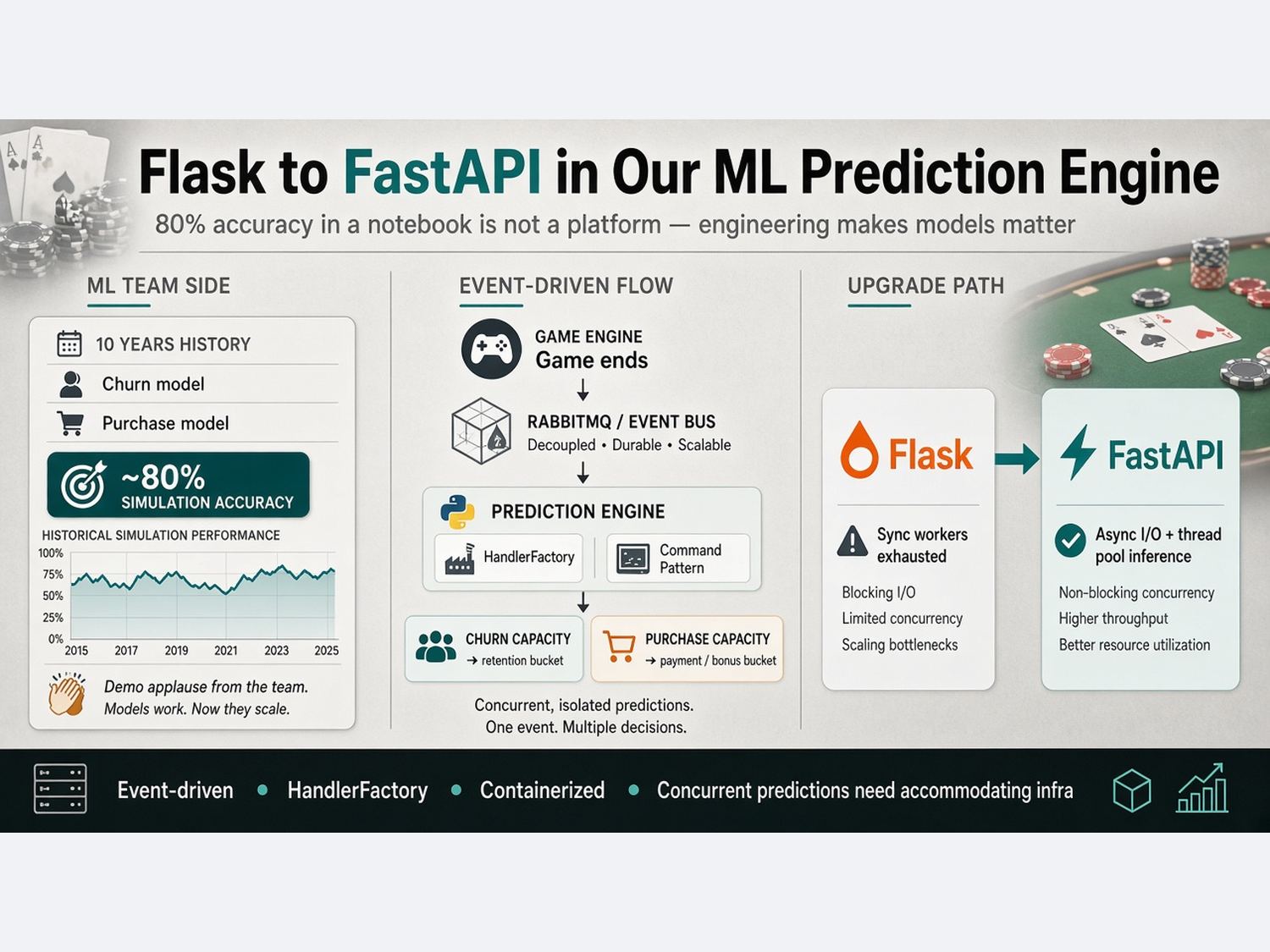
    Our ML analytics team had done serious work. They built churn and purchase models on ten years of player history, ran simulations, hit around 80% accuracy, demoed the room applauded. Then the ask landed on architecture when a game action ends in real time, execute the right model, return a prediction, and recommend payment and bonus buckets according to churn capacity and purchase capacity.

    That is a different problem from the notebook. An accurate model with no event-driven platform, no serving layer, and no infra under concurrent load does not change outcomes. It stays in a slide deck.

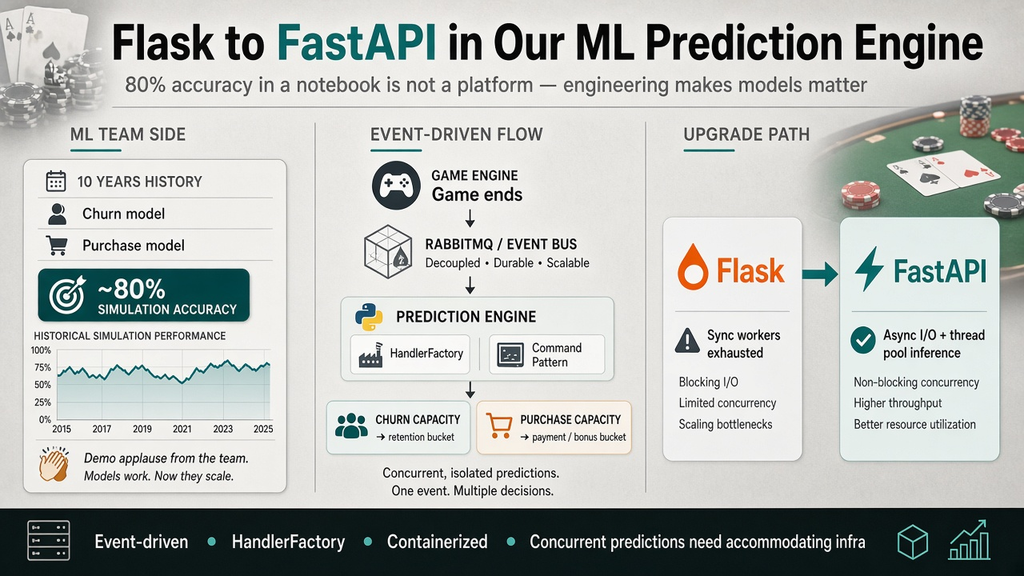
    This article is how we built that platform a Python Prediction Engine on Flask first, upgraded to FastAPI when concurrent predictions became the bottleneck and what we learned when ML and engineering had to work as one system.

    Accuracy is necessary. It is not sufficient.

    What ML delivered What the platform had to deliver
    Models on 10 years of historyReal-time scoring on live game events
    80% simulation accuracyLow latency under production concurrency
    Demo on sample dataIntegration with game engine and targeting
    Model artifacts handoffRouting by event — churn vs purchase handlers
    Works in the labPayment & bonus bucket recommendations in session

    The gap between those columns is architecture and engineering not another week of feature engineering alone.

    That gap closes only when ML and engineering are married, not when one team “finishes” and throws artifacts over the wall the same lesson we learned at the ARB before a line of platform code shipped.

    The business problem: act on the game, not on yesterday’s warehouse

    Players do not churn in batch files. They churn in sessions.

    When a game ends, we already know something useful: how they played, whether they won, how they bet, how long they stayed. The business wanted to use that moment to

    Estimate churn risk and steer retention offers

    Estimate purchase capacity and place the player in the right payment / bonus bucket

    Do it in real time— not after a nightly Spark job.

    So the game engine would emit an event whenever a relevant game action completed. Our job was to consume that event, call the right model, and return a recommendation the targeting and payments stack could act on.

    That became the Prediction Engine.

    How we designed it: event-driven, command pattern, handler factory

    We designed an event-driven flow.

    Game engine (game ends / action completes)

    → event on the bus

    → Prediction Engine consumes

    → HandlerFactory picks handler by event type

    → Model inference (churn or purchase)

    → Response: bucket / offer recommendation

    → CRM / targeting / payments path

    Command pattern + HandlerFactory

    Not every event should run every model. A game-end event might need a churn handler. A purchase-intent or cash-action event might need a purchase-capacity handler. We used the Command pattern.

    Each event type maps to a handler(a command object)

    A HandlerFactory returns the right handler from the event name / type

    The handler loads features, calls the model, shapes the response

    That kept the engine extensible. New model, new event — add a handler and register it in the factory. The game engine stayed dumb emit event, do not know model internals.

    Flask v1: ship fast, prove the path

    We built the first version in Python with Flask.

    Simple REST endpoints for health and internal ops

    Consumers pulled work from the messaging layer and invoked handlers

    Gunicorn workers behind a load balancer

    Containerized, load-tested, concurrency tests passed, deployed

    For a while it worked fine. Predictions landed. Buckets updated. The demo became production.

    What broke with Flask under high concurrent predictions.

    Load tests passing once is not the same as sustained concurrent predictions at gaming traffic.

    Flask’s default synchronous WSGI model became the ceiling

    SymptomUnder the hood (Flask sync WSGI)
    Latency spikes at peakEach request blocks a worker for full inference path
    Queue depth growsMore game-end events than free Gunicorn workers
    Upstream timeoutsTargeting / CRM cannot wait past SLA
    “Add workers” stops helpingCPU-bound predict() does not scale linearly with threads
    GIL pressurePython threads contend on CPU during heavy inference

    We were not failing because the models were wrong. We were failing because the serving model — one blocking request per worker — could not accommodate the concurrency profile once many tables ended games at once.

    Eighty percent accuracy does not help if the prediction arrives after the player left the screen.

    Why we upgraded to FastAPI (and what it actually fixed)

    This is not Flask vs FastAPI as a religion. It is match the framework to the load.

    We moved the Prediction Engine to FastAPI because we needed a better concurrency story at the API and orchestration layer.

    LayerFastAPI benefit for Prediction Engine
    I/O-bound workAsync routes while waiting on features, cache, downstream calls
    ContractsPydantic — fewer bad payloads hitting handlers
    IntegrationOpenAPI — CRM and internal consumers onboard faster
    InferenceCPU-bound predict() in thread pool — do not block event loop
    OperationsAsync shell + bounded inference workers — clearer scaling model

    FastAPI did not make the churn model smarter. It made the platform able to serve many concurrent predictions without worker exhaustion on the hot path.

    What we kept from the Flask design.

    Event-driven ingestion — unchanged idea

    HandlerFactory+ Command handlers — unchanged pattern

    Containerized deployment and autoscaling — still required

    Models from the analytics team — same artifacts, better house.

    The upgrade was the serving and concurrency layer, not a rewrite of the ML story.

    Thread pools at consumers — and why events still piled up

    Under concurrent load we used thread pools at the message consumers. That was reasonable for v1 each game-end event got a worker thread, the handler ran, features were fetched, XGBoost / RF / sklearn`predict()` executed, the result went out.

    It worked until events piled up.

    When many tables ended games at once, the pattern looked like this.

    Event 1 → thread blocked (feature fetch + predict)

    Event 2 → waits for free thread

    Event 3 → waits …

    Queue depth grows → latency grows → buckets arrive too late.

    Python’s thread model was part of the pain:

    A bounded thread pool caps throughput — backlog is inevitable under burst

    Many threads mean memory and context-switch overhead, not free parallelism

    Blocking I/O (RTQE, Cassandra, HTTP) ties up threads while they wait

    CPU-bound `predict()` keeps threads busy for the full inference window

    We were not GPU-bound. We were concurrency-shaped wrong for a burst of single-row tabular scoring.

    LayerThread pool at consumer (v1)Async + Uvicorn / uvloop (v2)
    Consume eventOne OS thread per in-flight eventawait — many events multiplexed on event loop
    Feature fetch (RTQE)Thread blocked while waiting on network/DBawait — thread not held during I/O wait
    XGBoost / RF predict()Thread blocked for full CPU inferencerun_in_executor — bounded pool, off event loop
    Under burst (game ends)Pool exhausted → events pile up → latency spikesI/O stays cheap; inference capped but queue drains faster
    GPU needed?No — tabular CPU modelsNo — fix serving shape, not hardware

    The async pattern: Uvicorn, event loop, and bounded inference

    The fix was not “more threads.” It was async for waiting, thread pool for predicting.

    We moved the Prediction Engine to FastAPI served by Uvicorn, with uvloop as the event loop where we could — a faster asyncio loop for I/O-heavy work. The pattern.

    async consumer / handler

    ├─ await consume event (I/O — event loop handles many in flight)

    ├─ await fetch features (I/O — RTQE / cache / HTTP)

    ├─ await run_in_executor(predict) (CPU — bounded thread pool, NOT on event loop)

    └─ await ack / publish result (I/O)

    Rules we enforced.

    1. Never call `predict()` directly inside `async def`— it blocks the event loop and recreates the pile-up.

    2. Bounded inference pool — cap concurrent XGBoost/RF/sklearn calls (semaphore or fixed executor size).

    3. Async for orchestration — consume, fetch, ack let the loop multiplex I/O.

    4. Scale out — more container replicas when queue depth rises async is not infinite capacity.

    uvloop did not make the models more accurate. It made the consumer path stop drowning in thread overhead when events stacked up. GPU would not have fixed that either our models are tabular, CPU-native, one player per game end.

    This is the same lesson as on the Java side with virtual threads at RTQE scale: match the concurrency model to what actually blocks I/O on the loop, CPU in a pool.

    The full stack picture

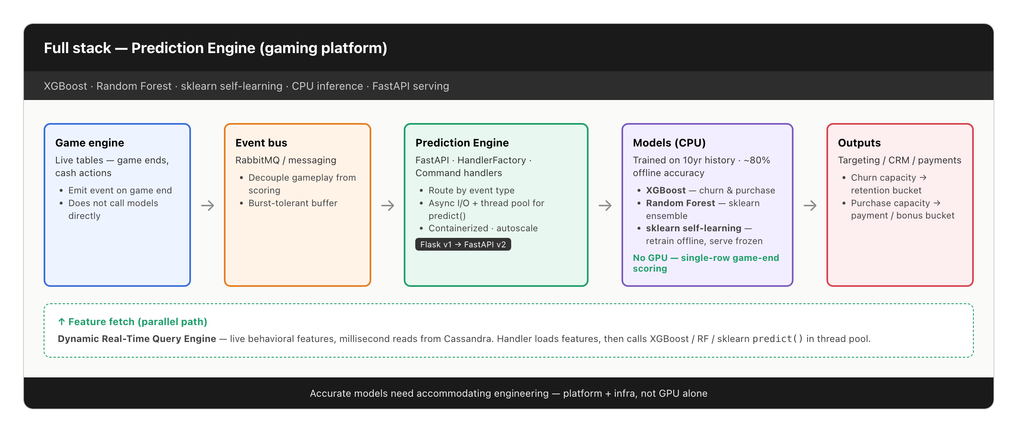
    Our models were tabular — not deep learning. The analytics team trained on ten years of history using XGBoost, Random Forest, and sklearn self-learning / incremental models. Simulation accuracy was strong (~80%). Serving them in production was a different shape of problem:

    Model familyRole in Prediction EngineServing note
    XGBoostPrimary churn and purchase scorersCPU inference — one player per game-end event; GPU not required
    Random ForestSupporting / ensemble paths (sklearn)CPU-only; keep forests lean for millisecond budgets
    sklearn self-learningIncremental updates offline; frozen artifact in prodRetrain on schedule — do not partial_fit on every live event

    GPU does not improve accuracy for this stack. It can help large-batch deep learning — not single-row XGBoost/RF scoring at game end. The bottleneck we hit was concurrent serving(Flask workers), not matrix math on a GPU.

    Flow in production.

    1. Game engine— live table ends; emits event (game end, cash action)

    2. Message bus— decouples gameplay from scoring (same event-driven seam as the modular game engines).

    3. Prediction Engine (FastAPI)— consumes event; HandlerFactory picks churn vs purchase handler.

    4. Feature fetch— live behavioral features from RTQE and related real-time services (often more latency than `predict()`).

    5. Model inference (CPU) — handler calls the right XGBoost / RF / sklearn artifact in a thread pool.

    6. Response — churn capacity → retention bucket; purchase capacity → payment / bonus bucket.

    7. Targeting / CRM / payments — act while the player is still in session

    Features came from the same real-time data path we had already built for segmentation the Dynamic Real-Time Query Engine and related platform services. Accurate models plus live features plus an engine that could keep up that is when recommendations started to matter in production.

    Lessons we took to the architecture board

    1. Demo accuracy ≠ production value. Simulation at 80% is a starting line. Without real-time integration and infra, it is a handoff to nowhere.

    2. Marry ML with engineering — or you will not get results. Separate ownership is fine; separate reality is not. Analytics trained on ten years of history architecture built the event-driven engine, feature path, and serving layer. Neither side wins alone. Handoff without partnership is applause without outcomes.

    3. The ARB is where ML, business, and engineering marry.Data scientists bring business and tech flavour together — simulation accuracy and model mechanics. Use the board to ask what must be true in production for the model to count as a result.

    4. Join model team and platform team at the seam. Analytics builds models; architecture builds the event-driven engine that runs them on live game actions — together, not in sequence with a six-month gap.

    5. Design for events, not cron. Game-end is a natural trigger. Command + factory keeps new models from polluting the game engine.

    6. Load test the serving path, not just the model. Concurrency tests on Flask passed — until production traffic shape changed. Test concurrent predictions, not one request at a time.

    7. Upgrade frameworks when the bottleneck is serving, not when a blog says so. Flask was the right v1. FastAPI was the right v2 for our concurrency profile.

    8. Async does not fix CPU-bound inference. Run `predict()` in a thread pool or dedicated workers. FastAPI wins on orchestration and I/O, not on magic faster math.

    9. XGBoost / RF / sklearn are CPU-native. Do not reach for GPU to fix accuracy or single-row game-end latency. Optimize the serving layer and feature path first.

    10. Thread pools at consumers are not enough under burst. Use async for I/O(Uvicorn / uvloop) and a bounded pool for `predict()`— never block the event loop with inference.

    When Flask is still fine

    Internal tools, low QPS, batch scoring

    Prototypes and first vertical slice

    Teams that will never see game-end burst concurrency

    When many game actions end at once and payments and bonus buckets must update in session, plan for serving architecture early not after the ML demo.

    Wrapping up

    Our ML team did serious work: ten years of history, churn and purchase models, 80% simulation accuracy, a convincing demo. None of that produces player outcomes until architecture gives you a Prediction Engine that.

    Consumes game events in real time.

    Routes through a HandlerFactory and command handlers.

    Runs models under concurrent load

    Returns payment and bonus bucket recommendations while it still matters.

    We started on Flask — containerized, load-tested, deployed, working. We moved to FastAPI when high concurrent predictions exposed the limits of synchronous serving.

    Marry ML with engineering. Eighty percent accuracy in simulation is not a result. An event-driven Prediction Engine at gaming concurrency is. Without that marriage models plus platform plus infra you do not get outcomes. You get applause in a meeting room.

    If you have shipped ML to production — what broke first the model, the features, or the serving layer? Drop a comment.