What we keep missing in the Architecture Review Board — and the drawbacks of each pattern
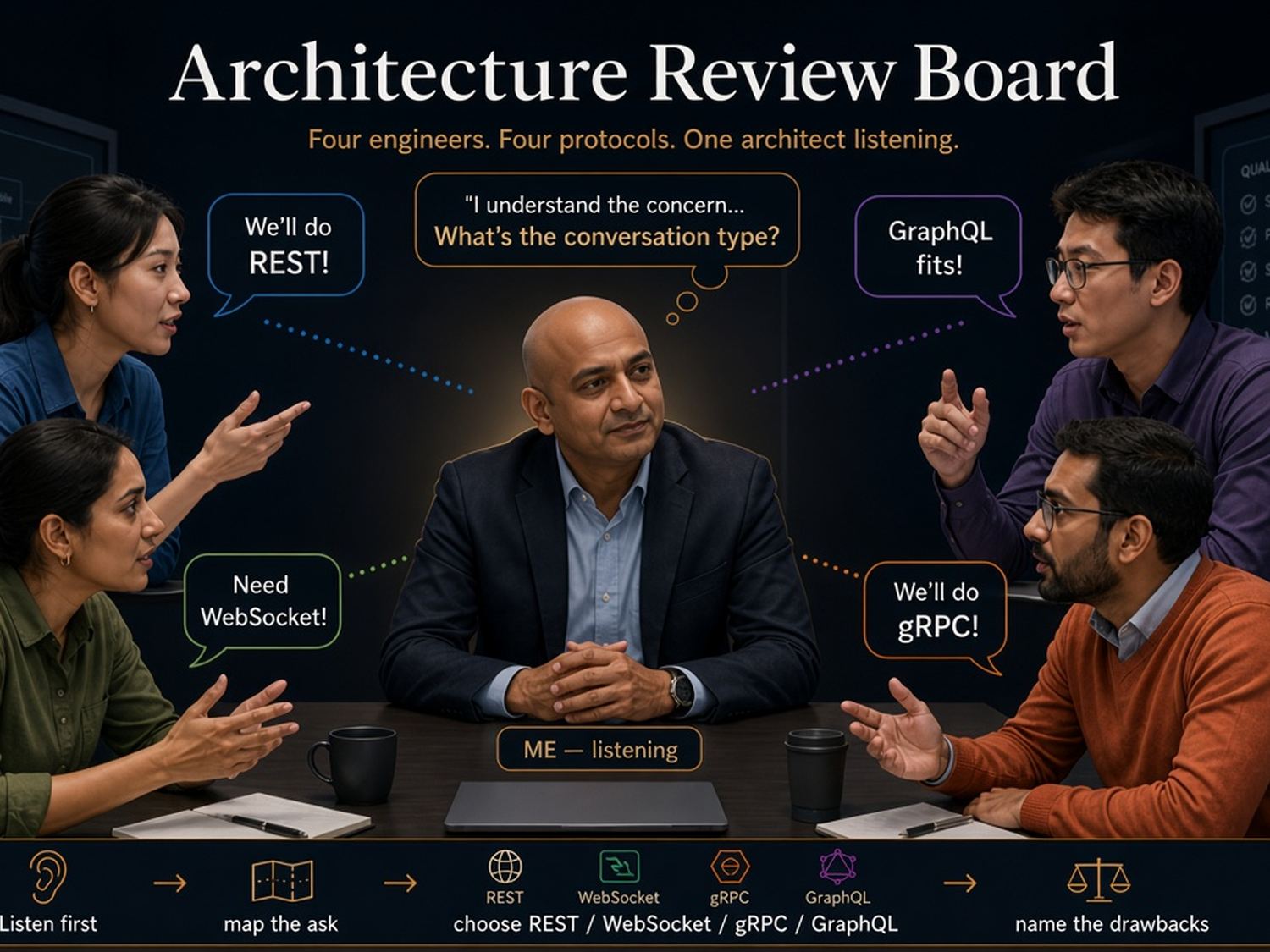
When a new requirement lands, we open the Architecture Review Board (ARB).
The room fills quickly. Mid-level engineers come prepared — and passionate. Someone says: “We’ll do gRPC.” Someone else: “GraphQL is better for the UI.” Another: “Just expose a REST API — everyone knows it.”Occasionally WebSockets enter the chat because “we need real-time.”
I understand the concern. Everyone is trying to move fast and pick a modern, credible tool.
But sometimes we miss the fundamentals between all of them.
gRPC, GraphQL, REST, and WebSocket are not competing logos. They are different communication patterns. They answer different questions about how long the conversation lasts, who is calling, how much of the data the client needs, and what fails when the network gets ugly.
In this article I explain when to choose which communication pattern, and — just as important — what the drawbacks of each are. The examples come from high-scale gaming and payments platforms we built: matchmaking, live tables, real-time query APIs, and service-to-service paths behind the client.
Same ARB energy. Clearer criteria.
What the ARB should ask before naming a protocol
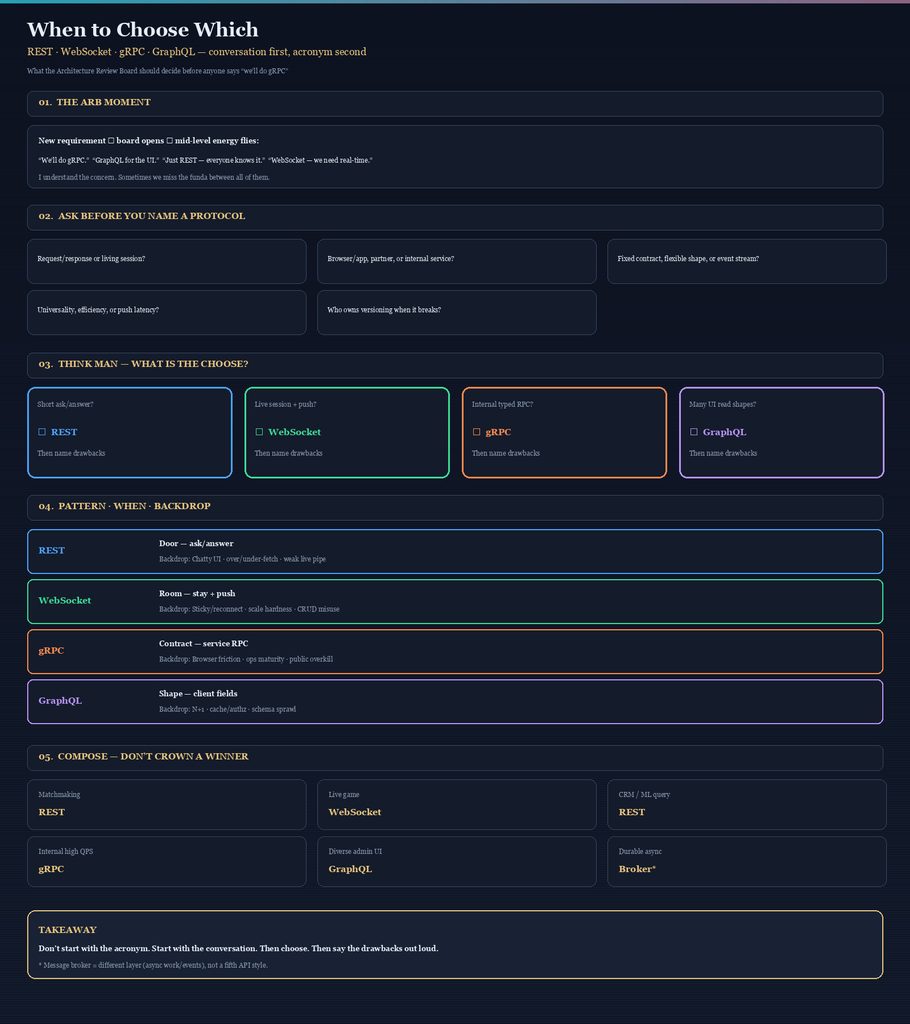
Before anyone says “gRPC” or “GraphQL,” force these questions:
1. Is this a short request/response, or a living session?
2. Is the caller a browser/app, a partner, or an internal service we control?
3. Does the client need a fixed contract, a flexible read shape, or a stream of events?
4. Are we optimizing for universality and debuggability, binary efficiency, or push latency?
5. Who owns versioning when the contract changes?
If you cannot answer those, you are not choosing a pattern. You are choosing a buzzword.
REST — when to choose it
Choose REST when the interaction is “ask and get an answer”: short-lived, resource- or command-oriented, and best served by ordinary HTTP (methods, status codes, gateways, caches).
Matchmaking was a scalable REST service. The client called it first. The service read live tables/seats from cache, applied rules, and returned game table info (later including a sticky cookie). Only then did the client know where to play.
The Dynamic Real-Time Query Engine exposed REST APIs so CRM, ML, and targeting could send a behavioral query and get a decision. Request/response. Wide consumer set. Spring Boot + HTTP was the interoperable door.
Why ARB likes REST (for good reasons)
Every platform can call it
API gateways already know how to auth, rate-limit, and route it
Easy to debug (`curl`, logs, status codes)
Natural for onboarding, config, “place me,” “get segment,” partner integrations
Drawbacks / backdrops
Chatty UIs — one screen may need many round trips
Over-fetching / under-fetching — one DTO rarely fits every client
Poor fit as the primary game loop — polling REST for table state is a smell
Versioning sprawl — `/v1` `/v2` and bloated payloads if governance is weak.
ARB line: If the conversation ends when the response returns, REST is the default until proven otherwise.
WebSocket — when to choose it
Choose WebSocket when you need a persistent, bidirectional channel: server push, client push, session as long as the user is inside an experience.
Where it fit for us
Gameplay was never REST polls. Early on, clients held a persistent socket for the life of the session — input in, broadcast out.
Later we moved to WebSockets behind an API gateway (auth, security, rate limits, routing).
Flow:
1. REST matchmaking → table info + sticky cookie
2. WebSocket through the gateway → live game path
3. Stay connected for the session; server fans out state
Historically we also separated lobby vs game connections so browsing spikes did not punish a live table.
Why ARB likes WebSocket
True real-time without fake polling
Efficient for many small messages after handshake
Matches how games, live ops, and collaborative UIs actually work
Drawbacks / backdrops
Operational hardness — sticky sessions, reconnect storms, heartbeats, backpressure
Gateway and LB behavior become architecture — not an afterthought
Horizontal scale is non-trivial — affinity, failover, “who owns this gameId?”
Abuse risk — open sockets are a DoS surface if rate limits and auth are weak
Wrong tool for one-shot CRUD — login and “get config” do not need a socket
ARB line: Use REST (or similar) to enter the room. Use WebSocket to live in the room.
gRPC — when to choose it
Choose gRPC when callers are services inside your trust boundary, you want a strict contract (Protobuf), and you care about efficiency, deadlines, and codegen. Where it fits in stacks like ours
Client-facing traffic stayed REST + WebSocket. gRPC earns its keep service-to-service:
High-QPS internal lookups (profile, features, decision helpers)
Strong typing across languages
Unary or streaming RPCs without inventing a private framing protocol
A fraud Decision API or internal RTQE neighbor might speak gRPC internally while broader consumers still see REST.
Why ARB likes gRPC
Compact binary payloads; strong performance story
Contract-first with breaking-change discipline
Deadlines, status codes, streaming built in
Excellent for polyglot microservices you own
Drawbacks / backdrops
Browsers are awkward — need grpc-web or a proxy; not “just fetch”
Ops complexity — HTTP/2 load balancing, observability, and client libraries must be mature
Less human-debuggable than JSON REST in a pinch
Overkill for simple public or partner APIs
False comfort — a `.proto` does not replace product thinking about failure modes
ARB line: gRPC for internal contracts. Do not force it to the client because it feels advanced.
GraphQL — when to choose it
Choose GraphQL when many clients need different shapes of the same domain, and REST over/under-fetching is slowing product teams — and you are willing to govern a schema.
Where it fits
BFF / app / admin / CRM consoles: screens that would otherwise need five REST calls or one monstrous DTO.
Where I push back hard
Hot game loops — use WebSocket state sync, not GraphQL as the table protocol
Simple commands — REST is clearer
Blind “GraphQL everywhere” — schema sprawl is an enterprise debt
Why ARB likes GraphQL
Clients ask for exactly the fields they need
One endpoint can serve many UI variants
Strong story for mobile and parallel frontends
Drawbacks / backdrops
N+1 and resolver cost — easy to create accidental database storms
Caching is harder than REST resource URLs
Authz must be field-aware — coarse gateway auth is not enough
Schema governance — without owners, GraphQL becomes a junk drawer
Subscriptions ≠ free real-time architecture — still need backplane thinking
ARB line: Choose GraphQL for read-shape flexibility. Do not choose it to avoid designing APIs.
Side-by-side: pattern vs backdrop
| Pattern | Choose when | Main drawbacks |
|---|---|---|
| REST | Short request/response; broad clients; gateways | Chatty UIs; over/under-fetch; weak as live game pipe |
| WebSocket | Long-lived bidirectional session; server push | Sticky/reconnect complexity; harder to scale; easy to misuse for CRUD |
| gRPC | Internal service RPC; strict contracts; efficiency | Browser friction; ops maturity required; overkill for public CRUD |
| GraphQL | Many clients, many read shapes | N+1; cache/authz hardness; schema sprawl |
How we composed them (what “good” looked like)
| Conversation | Pattern |
|---|---|
| Matchmaking / “where do I sit?” | REST |
| Live gameplay / presence | WebSocket |
| CRM / ML segment query | REST (+ JSON body) |
| Service-to-service, high QPS, strict | gRPC (internal) |
| Diverse admin / app reads | GraphQL (when UI diversity demands it) |
| Durable async side effects (e.g. money path) | Message broker — different layer, not a fifth “API style” |
What I say in the ARB when the suggestions fly
When someone says “we’ll do gRPC / GraphQL / REST,” I translate:
REST — “We need a door everyone can knock on.”
WebSocket — “We need a room that stays open and pushes.”
gRPC — “Two services we own need a tight, fast contract.”
GraphQL — “Many UIs need many shapes of one graph — and we will govern the schema.”
If the sentence is only “it’s modern,” that is not an architecture decision.
Wrapping-Up
In the ARB, mid-level energy is valuable. Protocol fashion is not.
Sometimes we miss the funda: REST, gRPC, GraphQL, and WebSocket solve different communication problems, and each brings drawbacks you must budget for — chattiness, connection ops, browser proxies, schema and resolver risk.
When a new requirement opens the board, don’t start with the acronym. Start with the conversation type. Then choose the pattern. Then name the backdrops out loud so nobody is surprised in production.
Enter with REST when you need a door.
Stay with WebSocket when you need a room.
Speak gRPC when services need a tight contract.
Offer GraphQL when many UIs need many shapes — and you will own the schema.